
About SAM
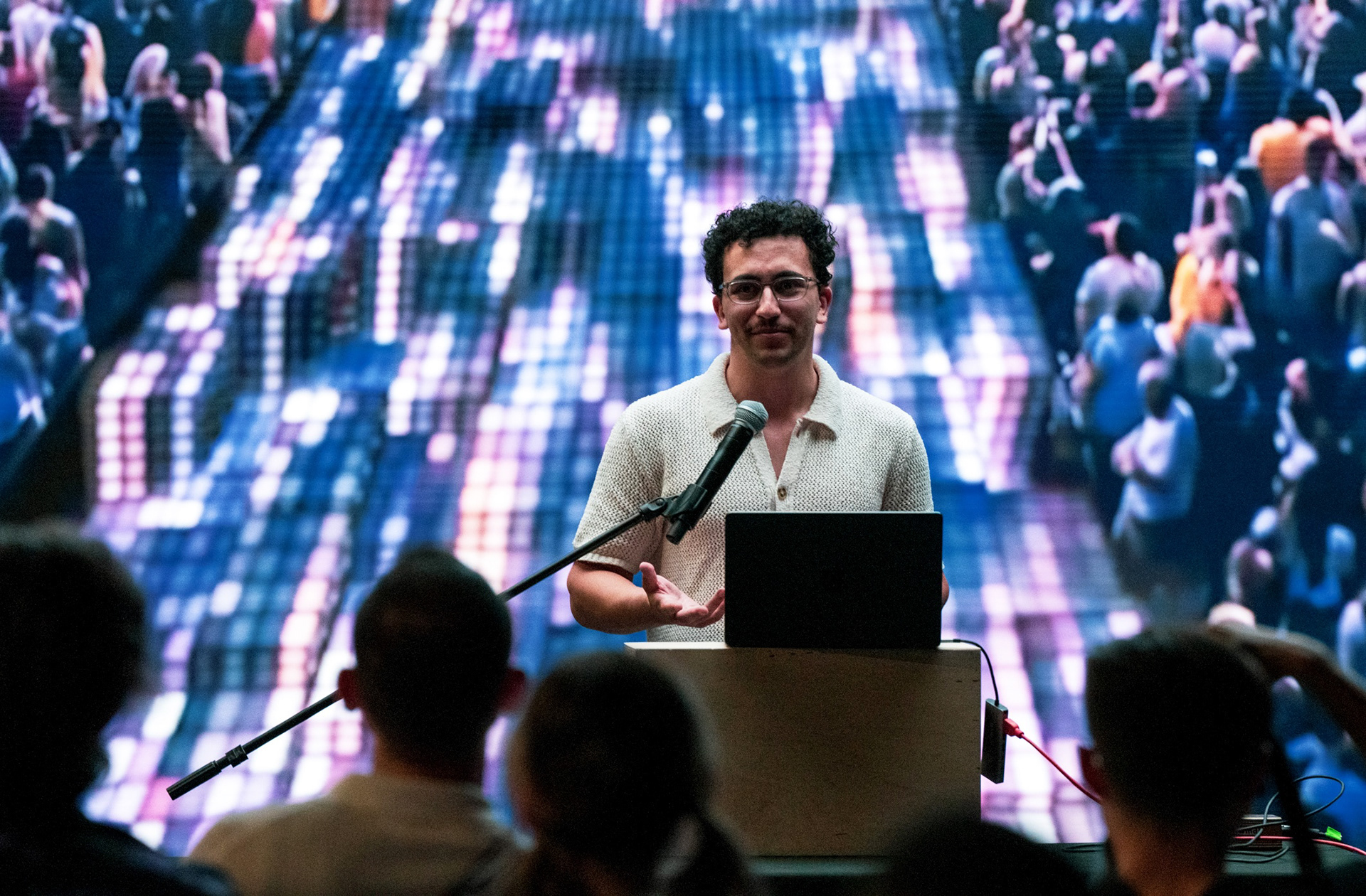
Sam Price is a New York City–based multimedia artist and designer whose work moves between shadow and light as two halves of a single inquiry into perception. While darkness is suggestive, holding every possibility, brightness is clarifying, resolving texture and space into form. Across art and design, he uses this interplay to shape how the built environment is seen and sensed.
Sam's art has appeared in venues including Cornell's Herbert F. Johnson Museum, Boston City Hall, and the Kennedy Space Center, and has been highlighted by outlets like VICE, 1stDibs, artnet, and STIR. In May 2026, his thesis project Boxels debuted at NYCxDESIGN's SHINE lighting exhibition, and his studio project Bookworms was featured at ICFF, with preorders now available. Selected honors include Cornell's Anderson Ranch Painting Scholarship, a Backslash Art grant, the Edith Adams & Walter King Stone Award, and the Elsie Dinsmore Popkin '58 Art Award. In 2024, he was curated into the first digital art collection archived on the Moon, and shortlisted by the Philadelphia Museum of Art for its 2024 Collab Student Design Competition.
Sam has collaborated with the Ponce Neuroscience Lab at Harvard and Cornell's Astronomy Department, and brought his design work to organizations including the Evan Eisman Company, WarnerMedia, and Jacques Torres Chocolate. He offers freelance design consulting and creates artwork under the name Sprice Studio.
Darkness and the unknown are catalysts for projection, interpretation, and belief. We are predisposed to seek meaning, even when there is nothing to reference. I’m drawn to pareidolia (our instinct to find patterns in noise) and to the moment when an image feels like it is emerging rather than fully declared.
This threshold is embodied in eigengrau (“intrinsic gray”), the dark, shifting field we see through closed eyes. It precedes dreams and many great ideas: a universal experience in which perception articulates structure from noise. My earliest painting process mirrored this phenomenon: starting with a black ground, adding color, and expanding on patterns until they stabilize into deeper meaning. This approach is less about depiction and more about discovery.
I’ve not only embraced emergence from darkness as a creative method, but as a broader cultural and technological lenses. I explore throughlines about how people react when information is missing: the uncanny valley effect, the social externalities that arise around uncertainty, and black boxes increasingly shaping life while resisting comprehension.
With my sculptural projection work, I extend this into space. I’m interested in the godlike creative impulse to evolve physical worlds from our minds, conceiving dynamic architectures that reverse the historical shaping of psychology by environment. At the nexus of art and technology, new tools offer truer translations of metaphysical ideas into material reality. But I’m more interested in what resists fidelity: the glitches, mistakes, and hallucinations that appear as our visions near “ground truth,” and the real-world externalities that follow.
Across painting, sculpture, and digital media, I stage the tension between clarity and distortion, inviting viewers to notice their urge to complete the picture. I aim to externalize the mind’s quiet labor of turning the unknown into form, so viewers can recognize it in themselves.
PRESS HIGHLIGHTS:
WHDH 7 News Boston: "Out Of This World Artwork" (2/23/24)
Are Poets the New Painters? (4/20/22)
What Inspires My Sculptural Projections? (9/14/22)
An Interview with Perime Gallery (2/01/2021)